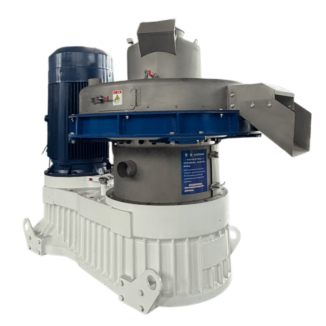
Small Wood Pellet Machine
Low investment and small footprint: The equipment price and installation cost are significantly lower than those of large industrial models, with minimal site requirements, allowing for rapid production deployment.
Turning waste into treasure and generating revenue: It can convert wood chips, shavings, agricultural and forestry waste, etc. into high-value fuel pellets on-site, which can be sold directly or used for personal consumption, thereby reducing energy costs.
Flexible adaptation to niche demands: It is highly suitable for producing specialized pellets for small boilers, household fireplaces, barbecue grills, or specific processes (such as cat litter), meeting personalized and segmented market demands.
Easy to operate and low energy consumption: The structure is relatively simple, making it easy to learn and operate; the supporting power is small, and the operating energy consumption is low, meeting the cost control requirements of small-scale production.
Clean and environmentally friendly, promoting recycling: Pellet fuel is clean and low-carbon, effectively solving the challenges of small-scale bulk material handling and achieving green recycling of local resources.
The Small Wood Pellet Machine is an environmentally friendly energy conversion device. It utilizes physical compression to directly extrude loose agricultural and forestry waste, such as sawdust, straw, and rice husk, into high-density cylindrical solid pellet fuel without the addition of any binder. These pellet fuels are dense and have a high calorific value, making them easy to store and transport. They can be used in fireplaces, boilers, biomass power plants, etc., realizing the resource utilization of waste.
 Core features
1. Compact design and low investment threshold
The equipment is relatively small in size and doesn't occupy a large area, making its requirements for production sites quite flexible.
The overall purchase cost and installation expenses are usually lower than those of large industrial models, making them suitable for initial investment and production by individuals, family workshops, or small farms.
2. Easy to operate and strong adaptability
Some models are equipped with an automatic lubrication system, which enables continuous operation and reduces the frequency of manual maintenance.
It has a wide adaptability to raw materials, and can process not only common materials such as sawdust and sawdust, but also various biomass materials such as straw and rice husk.
By changing the mold, particles of different diameters (such as 6mm and 8mm) can be produced, flexibly adapting to the needs of various applications.
3. Durable core components and high output quality
The core components of the machine, such as the ring mold and the pressure roller, are usually made of high-quality alloy steel and undergo special heat treatment, making them relatively wear-resistant and having a long service life.
The produced pellet fuel has a high density (some sources indicate it can reach 1.0-1.4), with a smooth surface, making it resistant to breakage and loosening, and of good quality.
4. Energy conservation, environmental protection, and resource recycling
By converting agricultural and forestry waste into biomass pellet fuel, we achieve the circular utilization of resources and reduce waste accumulation.
The produced pellet fuel, as a clean and renewable energy source, boasts high combustion efficiency and helps reduce dependence on fossil fuels.
 Technical parameters
Model | Capacity(KG/H) | Power(KW) | Size(mm) | Weight(KG) |
PKJ250型 | 100-200 | 15 | 1120*440*1050 | 400 |
PKJ300型 | 200-300 | 22 | 1280*560*1200 | 760 |
PKJ350型 | 300-400 | 30 | 1300*530*1250 | 850 |
PKJ400型 | 400-500 | 37 | 1400*650*1300 | 950 |
PKJ450型 | 500-700 | 45/55 | 1600*700*1600 | 1700 |
PKJ550型 | 700-1000 | 55/75 | 2000*900*1750 | 2400 |