Pellet Machine Dies
Determining particle quality: The pore size and aspect ratio of the mold directly determine the density, hardness, and molding rate of the particles, which are key to ensuring the value of the final product.
Impact on production efficiency: Optimized perforation rate and internal structure can significantly enhance the discharge speed and output, while effectively reducing unit energy consumption.
Excellent wear resistance and durability: The use of alloy steel and special processes such as carburizing and quenching make the mold surface extremely hard, with strong fatigue resistance and long service life.
Strong adaptability to raw materials: By changing molds with different parameters, the same machine can flexibly adapt to the pelleting needs of various raw materials such as wood chips, straw, and feed.
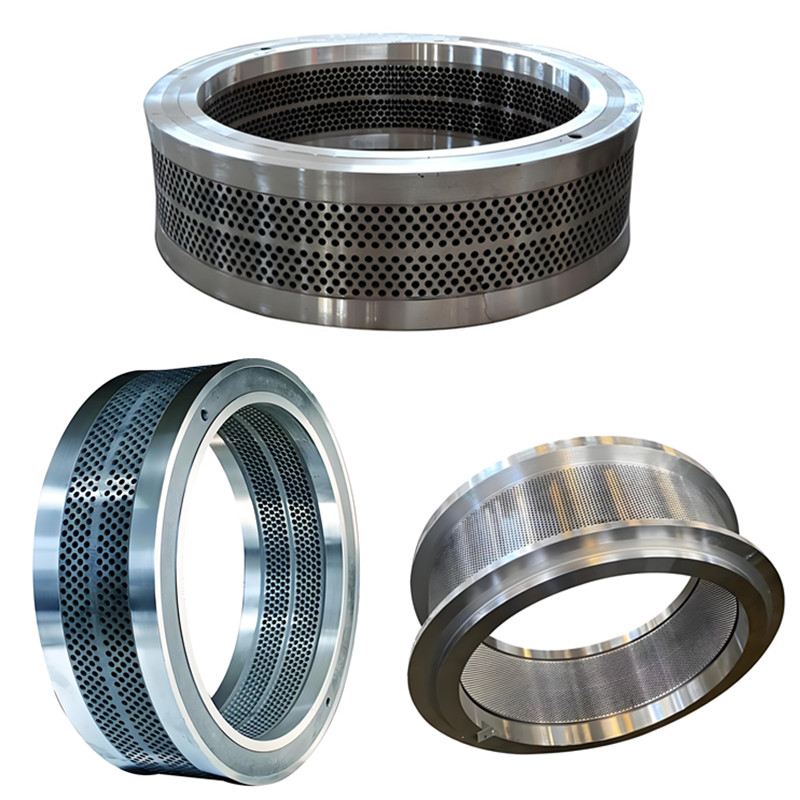
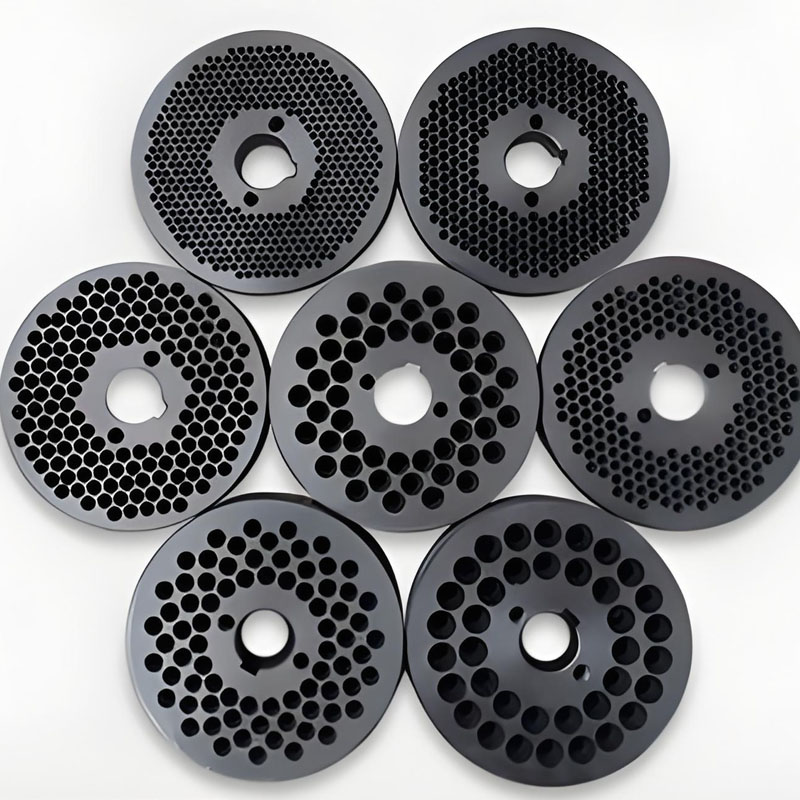
The pellet press mold is a metal disc or ring with numerous precision-drilled holes. It serves not only as a "template" for pellet formation but also as a crucial component for achieving extrusion, friction, and temperature elevation. The mold collaborates with the press roller, forcing the raw material through the mold holes under immense pressure, thereby densifying and solidifying it into cylindrical pellets.
 Molds are primarily categorized into two types, corresponding to different types of granulators:
Ring mold: a rotatable thick-walled ring with a pressure roller inside. High production capacity, good durability, and uniform particle quality. Stable operation, suitable for large-scale continuous production. Commercial and industrial production: the main choice for feed, wood pellets, and fertilizer plants.
Flat die: a horizontally placed stationary disc with a rotating pressure roller above. It has a simple structure, low cost, and easy replacement. It has a slightly wide adaptability to raw materials, but the output of a single machine is usually low. It is suitable for small and medium-sized production and experimental production: farms, workshops, and biomass fuel startups.
 Selecting the correct mold is the foundation for ensuring efficient operation of the pellet machine, and the following core parameters need to be considered:
1. Mold material and heat treatment
Core requirements: high wear resistance, high strength, and sufficient toughness.
Commonly used material: high-quality alloy steel (such as 20CrMnTi).
Key process: Carburizing and quenching. By infiltrating carbon elements into the surface of the mold and quenching it, it acquires the characteristic of "outer hardness and inner toughness" - the surface is extremely hard to resist wear, while the core remains tough to prevent cracking.
2. Die hole parameters
Pore size: Determines the diameter of the particles. The smaller the pore size, the lower the yield and the greater the pressure required.
Aspect ratio: refers to the ratio of the effective length of the mold hole to its diameter. It is the soul of mold design.
High aspect ratio: high extrusion resistance, high particle density and hardness, but reduced output and increased energy consumption.
Small aspect ratio: particles form quickly and yield is high, but the particles may be loose and fragile.
Feed inlet taper: An optimized taper can guide the raw material smoothly into the compression zone, reducing energy consumption and mold wear.
3. Perforation rate and wall thickness
On the premise of ensuring the structural strength of the mold, a higher porosity rate means more discharge channels, which helps to increase production.
 Use and maintenance of molds
Break-in of new molds: It is necessary to use soft materials mixed with oil (such as rice bran and sawdust mixed with oil) for at least 1 hour of break-in to smoothen the inner walls of the mold holes.
Reasonable material matching: Different raw materials (such as hardwood, straw, and feed) have different fiber structures and friction coefficients, requiring molds with different aspect ratios and pore sizes.
Uniform wear: The gap between the pressure roller and the mold needs to be adjusted regularly to ensure uniform wear between the two, thereby extending the overall lifespan.
Regular cleaning and inspection: The mold must be thoroughly cleaned during downtime to prevent material hardening and blockage. Regularly check the smoothness of the inner wall of the mold hole, and replace it promptly if severe wear or difficulty in discharging is found.