
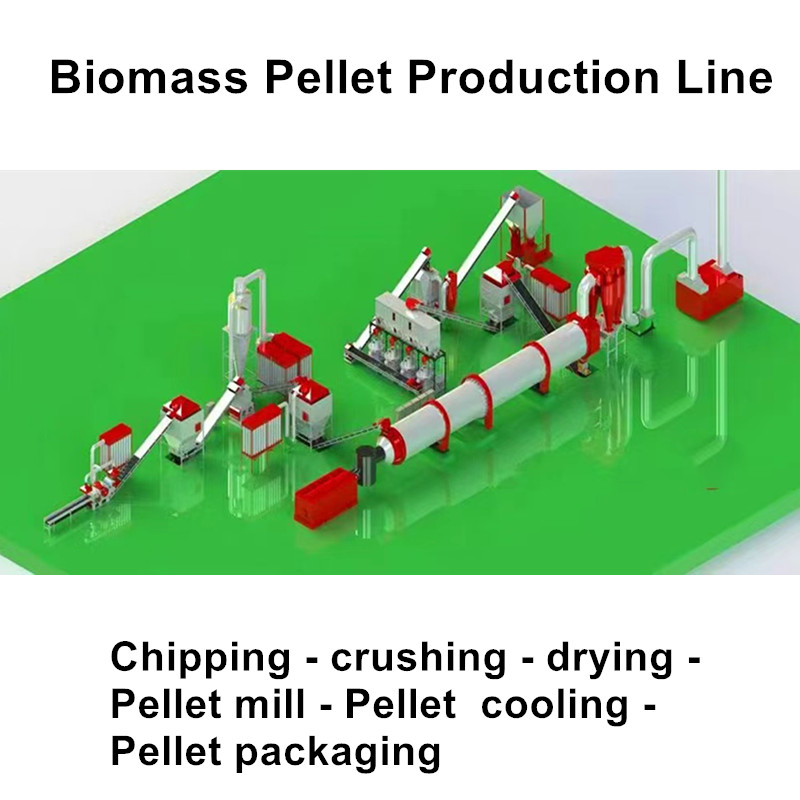
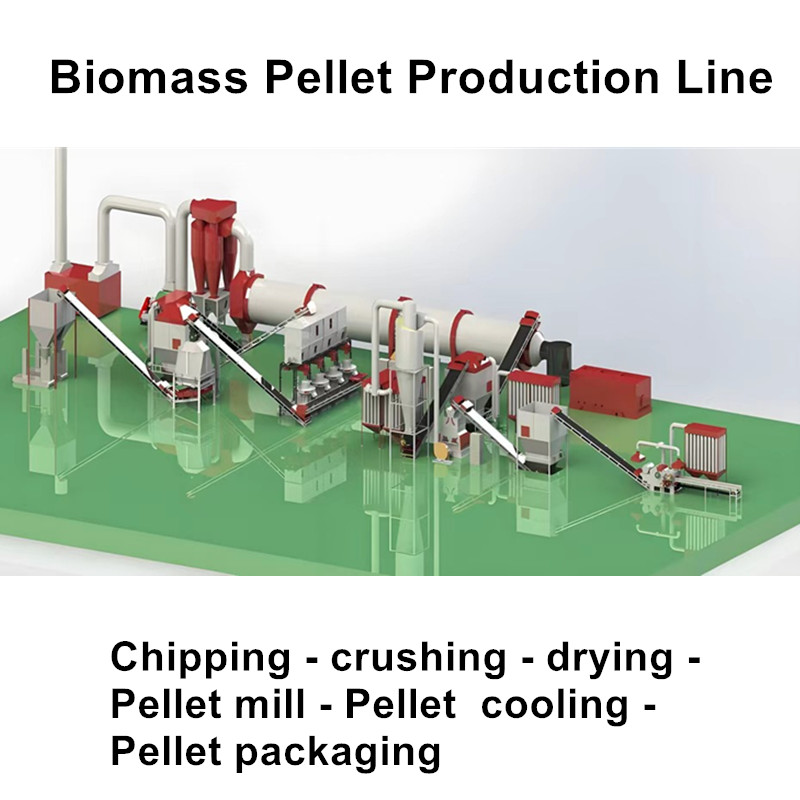
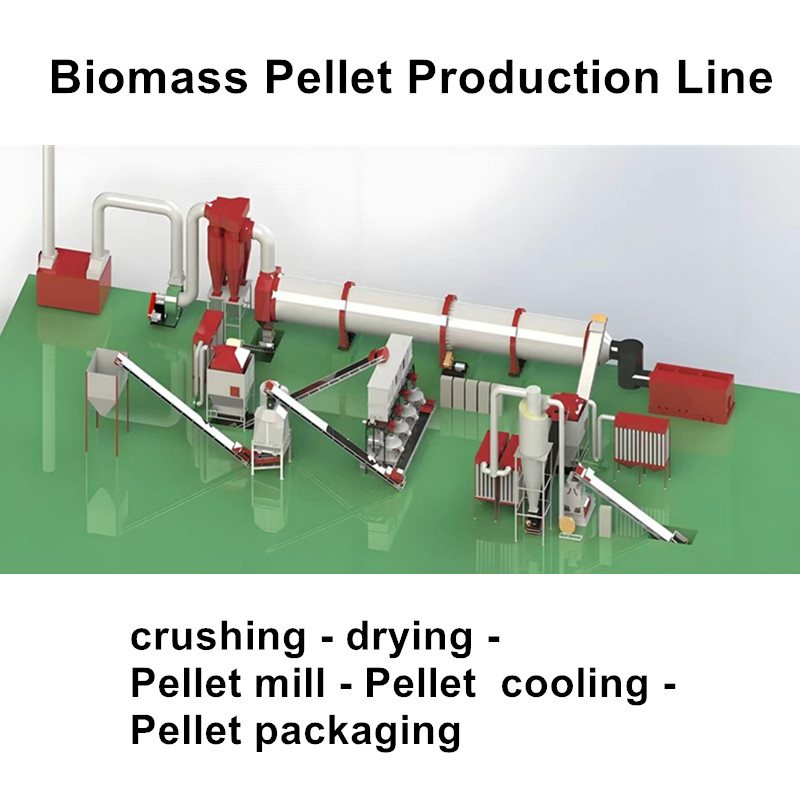
Biomass Pellet Production Line
Large-scale efficient production: Automated assembly line operations achieve large-scale stable production, significantly improving productivity and efficiency.
Significant economic benefits: transforming cheap agricultural and forestry waste into high-density commercial energy with high added value and considerable investment returns.
Strict and stable quality control: The perfect technology ensures that the particle density, calorific value and moisture content indicators are consistent, and the quality is stable and reliable.
Win-win situation in resource and environmental protection: effectively eliminate waste and reduce open burning; the product is clean energy, which helps reduce carbon emissions.
Intelligent and reliable operation: The central control system achieves automated production, with low failure rates and significant long-term operational cost advantages.
Introduction To Biomass Pellet Production Line
The biomass pellet production line is an automated or semi-automated production system that processes various agricultural and forestry waste materials (such as sawdust, straw, rice husk, etc.) through a series of processes including crushing, drying, pressing, and cooling, to produce high-density, regularly shaped solid briquettes. The resulting biomass pellets are a clean, renewable, and environmentally friendly energy source that can replace traditional fossil fuels such as coal. They are widely used in industrial boilers, residential heating, and biomass power generation.

Characteristics of Biomass Pellet Production Line
1. Resource recovery and environmental protection
The core value lies in the conversion of waste biomass into a valuable resource, reducing pollution caused by waste accumulation and open burning. The product is a clean energy source that achieves near-zero carbon emissions throughout its lifecycle, providing significant environmental benefits.
2. Automation and efficiency
The adoption of the PLC central control system has facilitated continuous and automated operations from raw material loading to finished product packaging, significantly enhancing production efficiency, reducing labor costs and work intensity, and ensuring stable production capacity.

3. Strict quality control and stable output
The production line integrates multiple key processes (such as fine crushing, uniform conditioning, and high-temperature pressing) to ensure that the produced particles maintain consistency in terms of density, calorific value, moisture content, and molding rate, resulting in stable and reliable product quality.
4. Operational economy and investment return
Although the initial investment is high, the production line can convert low-value raw materials into high-value commodity energy, with controllable operating costs. Long-term use can bring significant economic benefits and good investment returns.
5. Flexibility and strong adaptability
The production line equipment can adopt a modular design, allowing for flexible configuration and adjustment based on different raw material characteristics (type, particle size, moisture content) and production capacity requirements, with strong adaptability.


